
Good afternoon. Melbourne, Australia
Bart Wildash builds systems, gadgets, and experiments.
Event operations at Ludo, plus personal software and hardware concepts. This is the library, and it says plainly which things are built and which are still ideas.
Projects
A map of 17 active, nested, and archived experiments, grouped by the systems they naturally feed.
Anything marked as a concept is an idea worked through on paper. It is not something you can use yet.
Showing 17 of 17
Ludo Field Systems
Venue tools for real crowds: visitor wallets, live participation, pop-up networks, and the practical kit that keeps a day moving.
- 01LudoVisitor app and venue back office for planning your event day on the way in, then moving through gates, queues, and entitlements calmly.Active nowView project
- 02SencoCalm live-session platform for moderators: Q&A, polls, reflections, whiteboards, and useful follow-up.Active nowView project
- 03PlexusPop-up network kit for events, bundling routers, access points, kiosks, and the boring parts that make connectivity feel easy.Concept, not builtView project
Switchboard Comms
Personal comms infrastructure: routing, ringing, answering, and queue-native follow-up folded into one calmer system.
orbit.social & Halcyon
Spatial memory, calm social space, and interfaces where software behaves more like objects you can place, revisit, and trust.
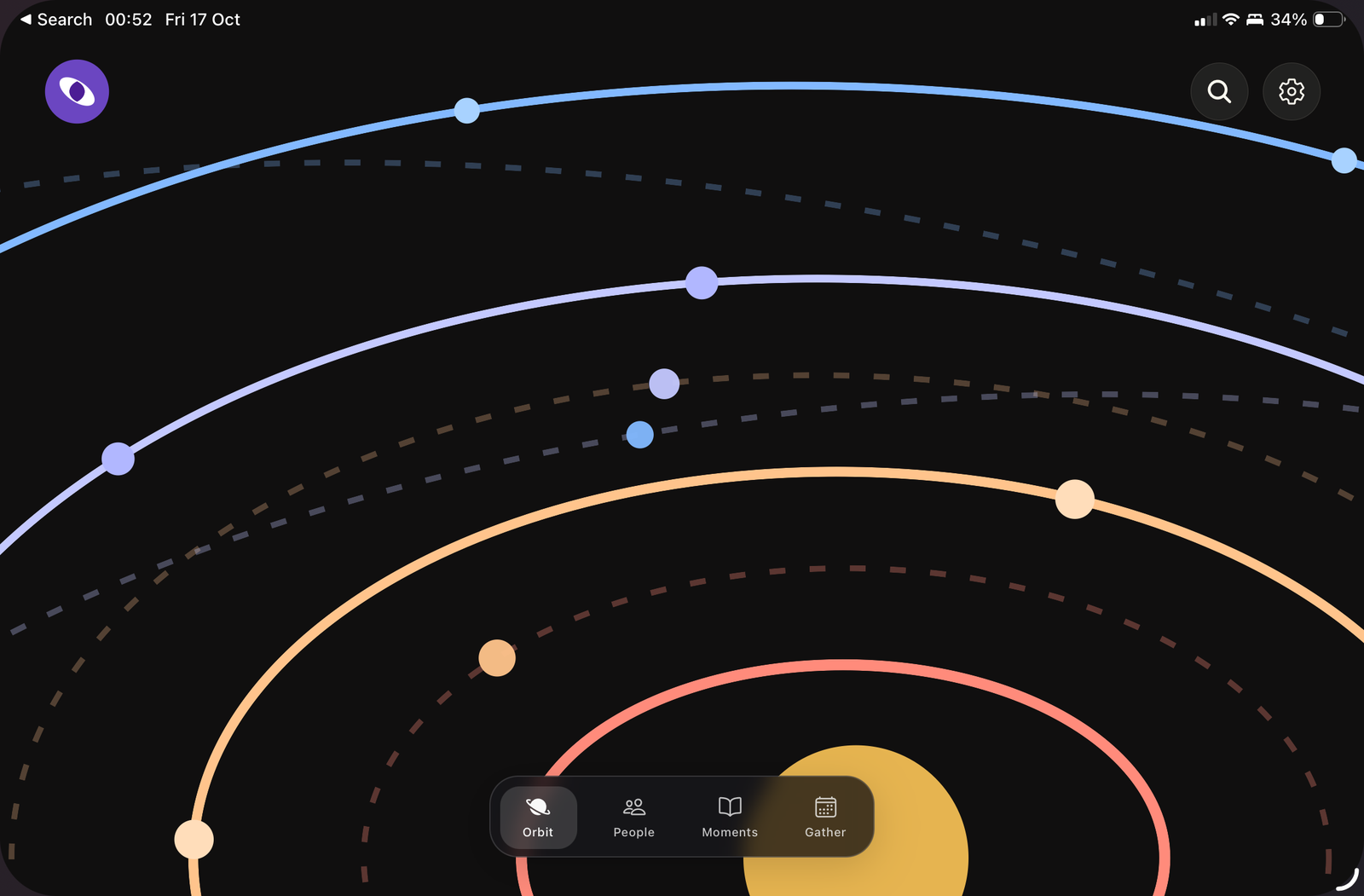
- 05orbit.socialA private map for the people closest to you: prompts, memory, and gentle gatherings without a feed.Active nowView project
- 06HalcyonSpatial deep-work environment where tools live as tactile objects across Study, Studio, Strategy, Garden, and Toy Room.Active nowView project
- 07CrumpitHalcyon's task brain: a tiny visual triage board for Do Now, Do Later, and Not Today when energy is low.Lives in Halcyon.Concept, not builtView project
Stor Memory Stack
Local-first memory and capture, with a small psychology assistant running close to the hardware rather than out in the fog.
Sol Field Power
Radial solar awnings and off-grid power objects for rigs, transporters, and quiet field work.
Canned Laughter
A standalone comedy object: small, physical, purple, and completely unserious in the best way.
Capture & Wearables
Personal objects for seeing, remembering, and changing modes without turning every moment into an app session.
Money & Civic Rails
Payment systems, early access, and public-good economics, with supporter benefits nested inside the money rail.
Social Robotics
Embodied AI and software as hospitality, explored on a small desktop robot.
Archive / Back Burner
Older ideas kept for provenance and pattern-matching, without pretending they are still at the front of the bench.
Get in touch
Have a project in mind, or just want to chat about systems, hardware, or experiments?